Motion · Act I
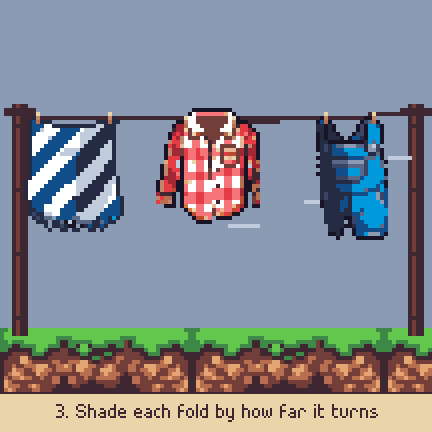
Flags and capes are three frames on repeat.
Lay a grid of points over the flat drawing, joined by links that keep their length. Pin a few, let gravity and wind push the rest.
Turn my flat pixel drawing into cloth: a pinned grid with Verlet physics, wind and shaded folds.
Read the whole briefFold the brief
Turn [my banner sprite] into cloth that hangs, sways, folds and can tear.

- Lay a grid over the sprite, a point every [3] px. Keep the squares that have pixels in them.
- Link each point to its neighbors: across and down, both diagonals, and two apart to resist bending.
- Pin the points [along the top edge].
- Each step: move every free point by its last move plus gravity and wind (Verlet), then pull every link back to its length, [8] times over.
- Wind comes in gusts, and pushes toward the viewer too: that is what makes folds.
- Draw each square with the sprite's own pixels, the nearest one, never a blend.
- Shade a fold one palette step darker as it turns from the light, two when it turns far.
- A pin lets go when the pull on it passes [a limit]. Then the cloth flies off.
Change what stands in [brackets] to fit your game.
- Cloth that hangs and is always in view: capes, flags, banners, curtains. The vampire's cape in Destroy Any Website is made this way.
- Any velvet-like material (or anything that could count as one! Be creative).
Not forClothes worn on an animated body: keeping cloth out of the body is the hard part.
Thomas Jakobsen made the method for Hitman: Codename 47 and presented it in 2001.[1] Jared Counts showed in 2012 how such a cloth tears.[2] In 2026 the script Heos Cloth did it for flat pixel drawings.[3] The figure is this atlas's own.
- Thomas Jakobsen, Advanced Character Physics, Game Developer
- Jared Counts, Simulate tearable cloth and ragdolls with simple Verlet integration, Envato Tuts+, 2012
- Make Your Aseprite Drawings Behave Like Cloth, 80 Level, 2026