Sprites · Act I
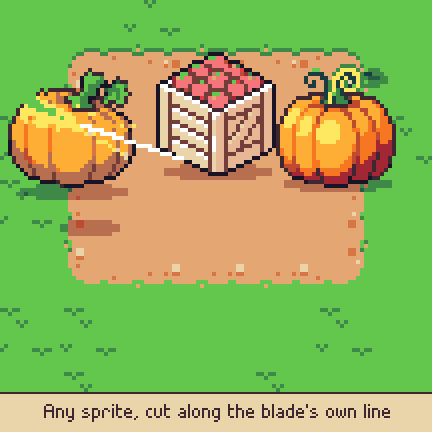
One death animation plays wherever the blade landed.
Cut the sprite itself. Each pixel goes to its side of the blade's line: two sprites, the same pixels. They fall, turn and can be cut again.
Slice my sprites along the blade's line into two real halves that fall apart, pixel perfect.
Read the whole briefFold the brief
Let my blade slice any sprite in two along the line it took.
Use it on [crates, pumpkins and defeated enemies] in my [top down] game.

- The cut is a line from where the blade entered to where it left.
- Each opaque pixel goes to the side of the line it is on. Touching pixels on one side are one piece.
- Each piece becomes a sprite of its own, its pixels where they were. It can be cut again.
- Brighten the pixels along the cut, so the cut face shows.
- Pieces hop apart, turn and come to rest, with [a short designed fall].
- Turn them with three shears (Paeth), in steps of [15] degrees: no pixel lost, none blended.
- A piece under [12] pixels joins its neighbor: no dust.
Change what stands in [brackets] to fit your game.
- Breakable props. One rule covers every sprite, with no art added.
Not forA sprite in the middle of an animation: freeze the frame first, you cut a picture. And cap the cuts, each one doubles the pieces. Also not for explosive destruction, etc.
Turning a picture by three shears, which keeps every pixel, is Alan Paeth's method of 1986.[1] Slice shaders sort pixels by the side of a line they lie on.[2] Pyxis turns its bodies of pixels by shears too.[3] The figure is this atlas's own.
- Rotation by shearing: notes on Alan Paeth's paper
- Slice: a pixel perfect slice shader, Godot Shaders
- Peyton, Pyxis