Color · Act I
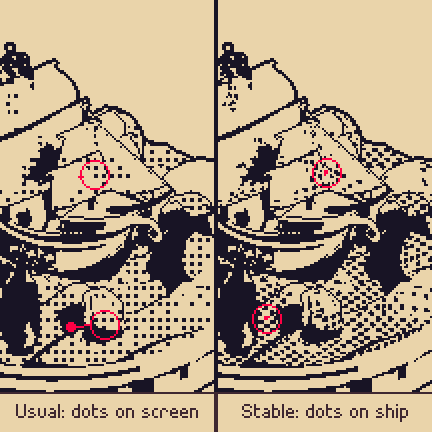
The dither pattern in pixel art is usually fixed to the screen, so how do you solve that for 3D-rendered pixel art styles? Give each surface its own grid of dots, so they ride with it. The grid comes in levels, each twice as fine. Use the level that keeps the dots the same distance apart on screen: come closer and new dots appear between the old ones.
Make my dither surface-stable: dots placed in UV space, in fractal levels that hold their size on screen.
Read the whole briefFold the brief
Shade my 3D scene in [two colors] with dither dots that stick to the surfaces: surface-stable fractal dithering.
Scene: [a galleon on a storm sea, with a camera that orbits and zooms].

- Place the dots in each surface's UV space, not in screen space. Where a mesh has no UVs, use world-space box mapping.
- Per pixel, take the screen-space derivatives of the UVs and find their smallest and largest rate of change (singular values).
- Dot spacing on the surface follows the smaller rate, so dots seen at a slant are squeezed, not stretched. Its log2 gives a whole level and a fraction.
- Scale the UVs by 2 to the power of the level. Tile [4 x 4] dots in Bayer order: the first quarter of them is the same pattern at twice the spacing.
- Across one level, show from a quarter of the tile's dots to all of them, by the fraction. Zooming in only adds dots, never removes one.
- Brightness sets how many dots there are and leaves each its size. Snap it to [4] tones: paper, few dots, many dots, ink.
- Draw outlines from depth, so shapes read without the dots.
- At low resolution keep dots [3] px across or more and leave small parts solid.

Show me one camera move with both side by side: this, and screen-space ordered dither.
Change what stands in [brackets] to fit your game.
- One-bit or halftone 3D with a moving camera: the shimmer goes, and the dots read as texture on the things.
Not forFlat 2D art and still screens: ordered screen dither is cheaper and crisper there. Nor very low resolutions, where small dots on small shapes turn rough.
Rune Skovbo Johansen devised it after Return of the Obra Dinn, whose dither holds under camera rotation only.[1] His open code adds dots on zooming in and removes none.[2] Aras Pranckevičius ported it to the Playdate.[3] The print here is this atlas's own.
- Rune Skovbo Johansen, Surface-Stable Fractal Dithering, runevision.com
- Rune Skovbo Johansen, Dither3D, GitHub, 2025
- Aras Pranckevičius, Surface-Stable Fractal Dither on Playdate, aras-p.info, 2025